
Planning a Fragrance Museum or Scent Experience: Timeline and Lead Times
A fragrance museum or scent experience is a brand asset with industrial-grade lead times: expect the concept, the space, the scent engineering and the fit-out to consume the better part of a year, even with a fast team. The scent part is rarely the bottleneck — the architecture, the audio, the dispensing systems and the safety checks are. Plan the museum as a product launch, with phases and gates, not as a decoration project.
Key takeaways
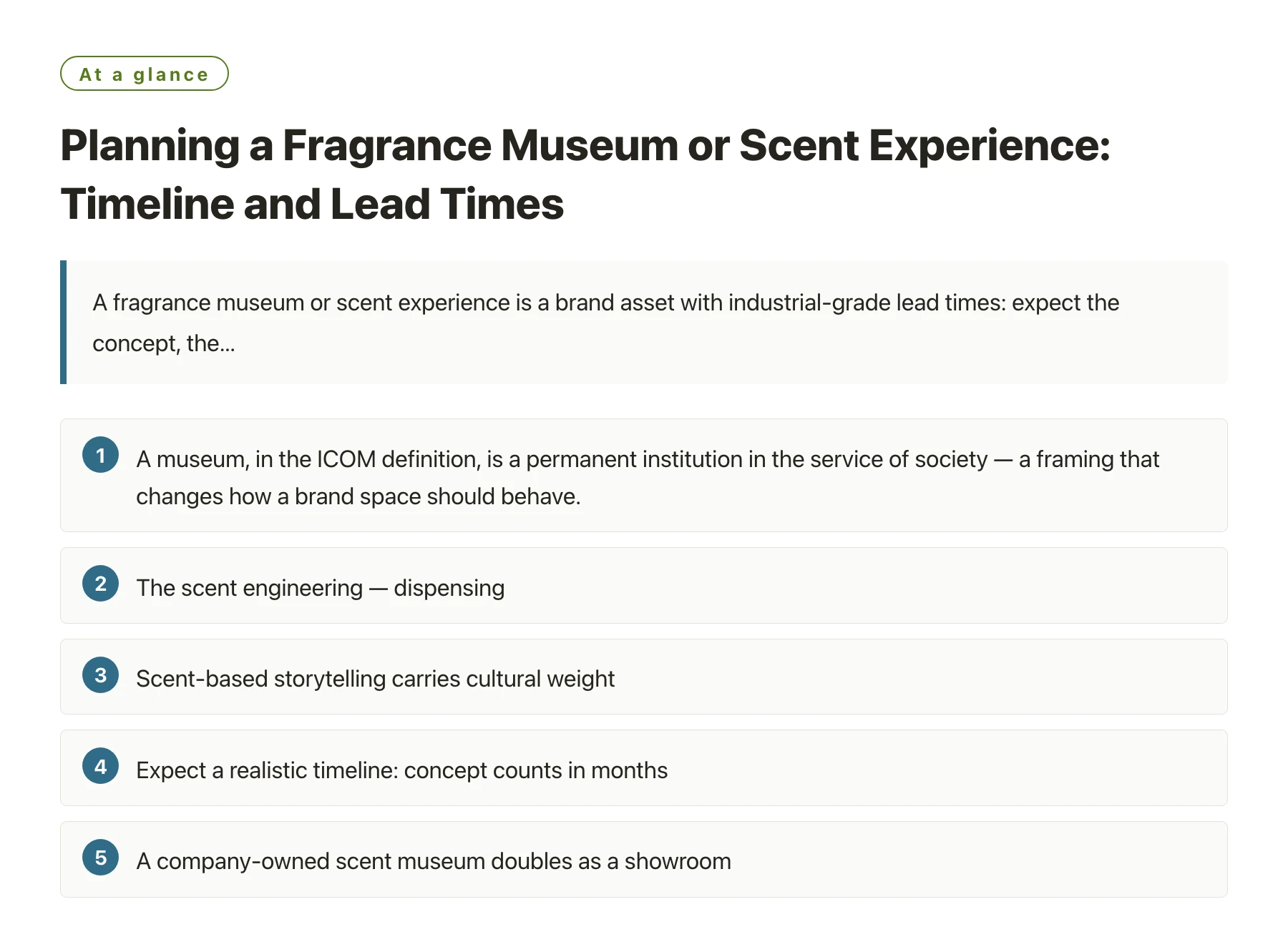
- A museum, in the ICOM definition, is a permanent institution in the service of society — a framing that changes how a brand space should behave.
- The scent engineering — dispensing, diffusion, refresh cycles — needs design and safety review, not just a pleasant aroma.
- Scent-based storytelling carries cultural weight; perfume traditions are treated as cultural practices in UNESCO's intangible heritage work.
- Expect a realistic timeline: concept counts in months, so does fit-out, and the scent installation should be booked early.
- A company-owned scent museum doubles as a showroom, a training ground and a press asset — plan all three uses from the start.
Brands build scent experiences for many reasons — a showroom that sells the story, a training space for retail partners, a press magnet, or simply a museum as a long-term brand asset. Whatever the motive, the mistake is the same: treating it as an interior design project with a scent added at the end.
A scent museum is closer to a product launch. It has components most teams have never scoped — olfactive displays, diffusion infrastructure, refresh cycles, safety — and they all run on their own clocks. This article lays out the phases and the lead times that actually show up.
What a scent museum actually is
Start with the definition, because it sets the standard. The International Council of Museums defines a museum as a permanent institution in the service of society and its development — a definition that demands collection care, interpretation and public benefit, not just a branded room [1].
A company-owned scent museum sits somewhere between that definition and a showroom, and the honest planner acknowledges both roles. The public-facing museum builds legitimacy; the showroom side pays the bills. Designing for both from the start is cheaper than retrofitting either.
A scent experience is also only as credible as the operation behind it — visitors will eventually ask who runs the factory whose history you are telling. Assessing the company behind the factory is part of the planning decision, not a detail for later the company behind the factory.
From concept to opening
- Concept and positioning (weeks 1–8)Story, audience, space program, budget envelope, and the definition of success for the first year.
- Space and design (months 2–5)Architecture, visitor flow, lighting, accessibility, and the room-by-room olfactive plan.
- Scent engineering (months 3–7)Dispensing and diffusion systems, refresh cycles, scent-safe materials, and safety review.
- Content and exhibits (months 4–9)Olfactive displays, interpretation, audio, labels, and the narrative arc of the visit.
- Fit-out and commissioning (months 8–12)Installation, system testing, staff training, and a soft opening before the public launch.
Where scent work becomes cultural work
A museum that tells the story of perfume quickly discovers that scent traditions carry cultural weight. UNESCO's intangible cultural heritage framework recognises perfume-making practices as living heritage — the know-how of Grasse perfumery is inscribed there — which is a useful calibration for how seriously to treat the craft in the exhibits [2].
The practical consequence: plan the narrative with the same care as the hardware. Visitors remember the story the exhibits tell long after they forget the diffuser brand, and a museum that treats scent as a theme park effect teaches nothing.
There is also an operational decision hiding in the cultural framing: who owns the interpretation? A museum written purely by the marketing team tends to read like a brochure; one built with perfumers, historians and museum designers gains a voice visitors trust. Even a small team can borrow this discipline — draft the exhibit text with the people who made the products, then edit it from the visitor's chair rather than the company's.
The refresh cycle applies to stories as well as hardware. Exhibits that never change teach the same lesson to the same audience twice, and repeat visitors are the ones who make a museum feel alive. Budget a quarterly content rotation from the start, even if it is only one scent station and one label.
Learning from existing examples
The most-cited reference in China's scent tourism is a fragrance museum in China that a manufacturer built around its own production story — a company-owned museum that doubles as a showroom and training venue a fragrance museum in China. Its visitors note two things: the olfactive exhibits are the draw, and the opening hours and tour structure matter more than the building.
Before planning a visit, check the practical details on the museum's own pages — the official Xuelei website publishes its visitor and program information, which is also the fastest way to see how the museum positions itself between education and marketing the official Xuelei website.
Budget for the boring quarter. Scent systems fade, nozzles clog, labels peel — every serious scent experience schedules a refresh cycle in the operating budget, and the ones that skip it are remembered as "the museum that used to smell nice."
Sources
- ICOM — International Council of Museums —— The international organisation representing museums; publishes the ICOM museum definition and professional standards for museum practice.
- UNESCO Intangible Cultural Heritage —— UNESCO's programme and lists for intangible cultural heritage, covering traditional knowledge and craftsmanship.
Frequently asked questions
How long does a fragrance museum take to build?
Plan for twelve months from concept to opening for a modest space, and more if the building work is complex. The scent engineering is rarely the critical path; design, construction and commissioning usually are.
What should a scent experience budget include?
Beyond construction: dispensing and diffusion hardware, scent refill stock, safety review, exhibit content production, staff training, and a recurring refresh budget for the olfactive systems.
Should the museum be profitable or a marketing expense?
Most company-owned scent museums are treated as a brand investment with a small revenue stream from tickets, retail and events. Plan the economics as marketing with a payback story, and design the revenue early rather than after opening.
How do visitors interact with scent in a museum?
Through a mix of dispensing stations, scent walls, scratch-and-sniff interpretation and staff-led experiences. Good design limits olfactory fatigue — a museum that blasts scent everywhere teaches the difference between smelling and sensing.
Do private museums count as real museums?
By the ICOM definition, institutional purpose matters more than ownership. A company-owned museum can behave like a public institution — collection care, interpretation, access — or like a showroom. Visitors and reviewers notice the difference.
The Q1 Shortlist